Restore Your Property
Get your yard and driveway back to normal as quickly as possible.
Fast, comprehensive Storm Damage Tree Removal Bonny Hills residents count on after severe weather events.
Expert storm cleanup for Bonny Hills and the wider Port Macquarie area.
In the aftermath of severe weather, our Storm Damage Tree Removal Bonny Hills service provides comprehensive cleanup. We clear driveways, remove shattered canopies, and restore safety to your property.
Coastal gales and autumn East Coast Lows frequently batter Bonny Hills, leaving properties littered with heavy eucalypt limbs and palm fronds. We specialize in fast, bulk cleanup.
Get your yard and driveway back to normal as quickly as possible.
We identify and remove hanging branches that could fall weeks after the storm.
You don't need to lift a finger—we cut, chip, and remove everything.
We assess the extent of the damage across your property.
We tackle suspended branches and blocked access routes first.
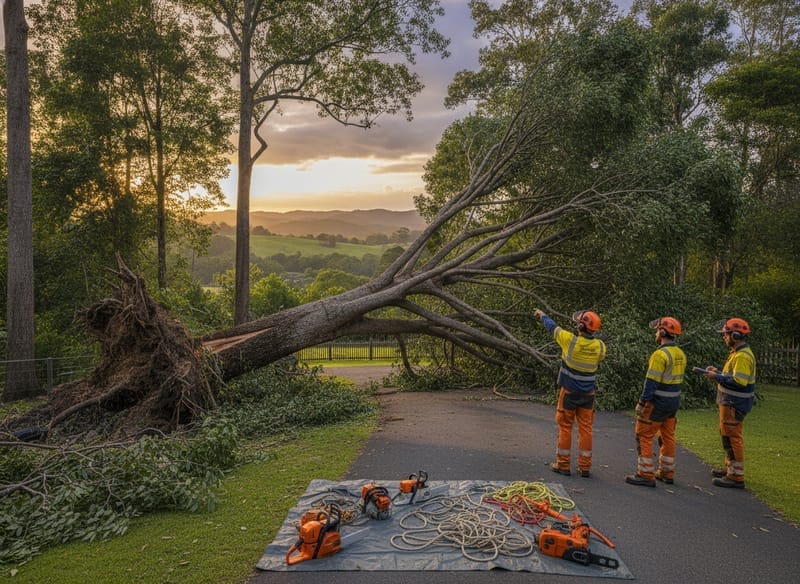
Using chainsaws and rigging, we relieve tension in fallen trees to cut them safely.
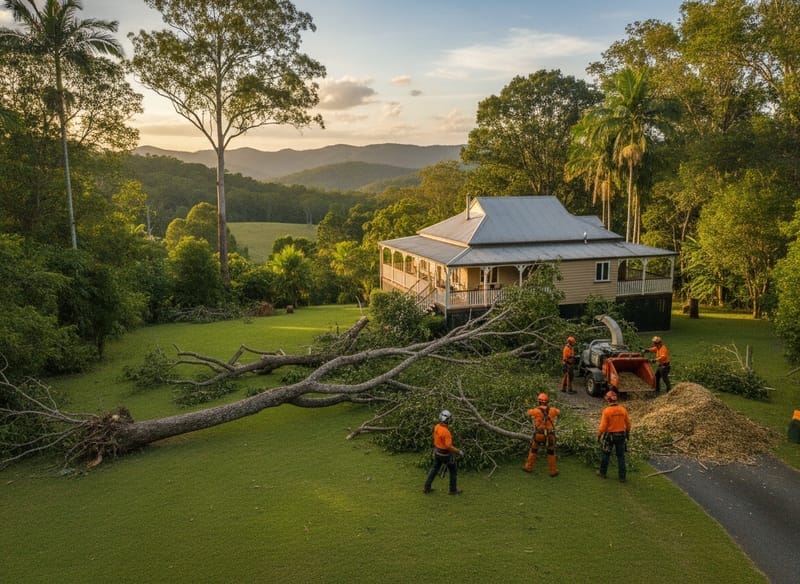
All debris is fed into our high-capacity wood chippers.
We check standing trees to ensure they are safe before we leave.
When East Coast Lows and fierce summer storms batter the Mid North Coast, established coastal eucalypts can take a serious beating. If you are dealing with fallen branches, uprooted trunks, or hung-up limbs threatening your home, you need immediate Storm Damage Tree Removal Bonny Hills. Our local team of qualified arborists understands the urgency of securing your property after a severe weather event.
Bonny Hills features a mix of exposed coastal beachfronts and established acreage blocks set against heavy bushland. Saturated sandy soils and driving coastal winds often lead to sudden root-plate failures in mature blackbutts, tallowwoods, and forest red gums. We provide a rapid, professional response to homeowners, builders, and property managers throughout Bonny Hills and the surrounding Port Macquarie suburbs.
Whether a massive tree has crushed a fence on a steep hinterland block, or dropped major limbs onto a narrow access road, our climbers and trucks are equipped to handle the cleanup safely, methodically, and efficiently.
Following a severe coastal blow, DIY cleanup or relying on under-qualified contractors can turn a highly stressful situation into a dangerous one. Hung-up limbs, tension-loaded fallen trunks, and shattered canopies carry immense kinetic energy. One wrong cut with a chainsaw can cause a massive limb to snap back or roll, resulting in catastrophic injury or further property damage.
Furthermore, partial tree failures often leave standing trees structurally compromised, even if they look relatively intact to an untrained eye. If these are not assessed by an AQF-qualified arborist, a minor secondary weather event could easily bring the rest of the tree down onto your roof or vehicle. We never recommend "lopping" or topping a damaged tree to try and save it; these outdated practices leave large stubs that promote weak epicormic regrowth and accelerate decay, ultimately shortening the tree's life.
Our professional approach ensures a safe, systematic resolution. We do not just hack away at fallen debris. Our climbers and ground crew utilise advanced rigging, cranes, and elevating work platforms (EWPs) where necessary to dismantle hazardous trees piece by piece. We also rigorously assess standing trees for latent storm damage, such as twisted trunks or fractured branch collars, applying AS4373-compliant pruning if the tree can be safely retained, or recommending complete extraction if the structural integrity is entirely lost.
Handling compromised timber requires specialised techniques, strict safety protocols, and commercial-grade equipment. Here is how our arborists safely execute storm damage tree removal across Bonny Hills and the wider Port Macquarie area.
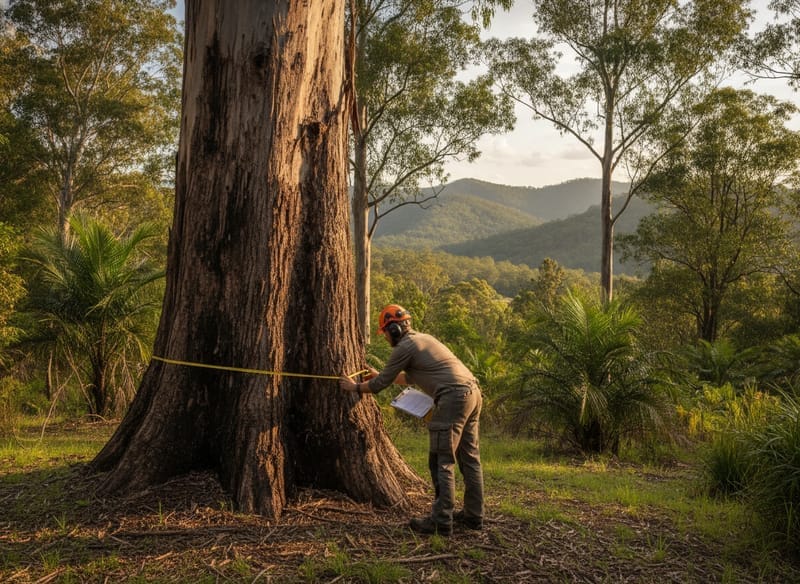
We systematically walk the property and tag trees by priority. Immediate hazards over houses, powerlines, or access roads are handled first, followed by secondary hazards like hung-up limbs, standing-but-compromised trees requiring AQF Level 5 assessment, and finally, open ground cleanup.
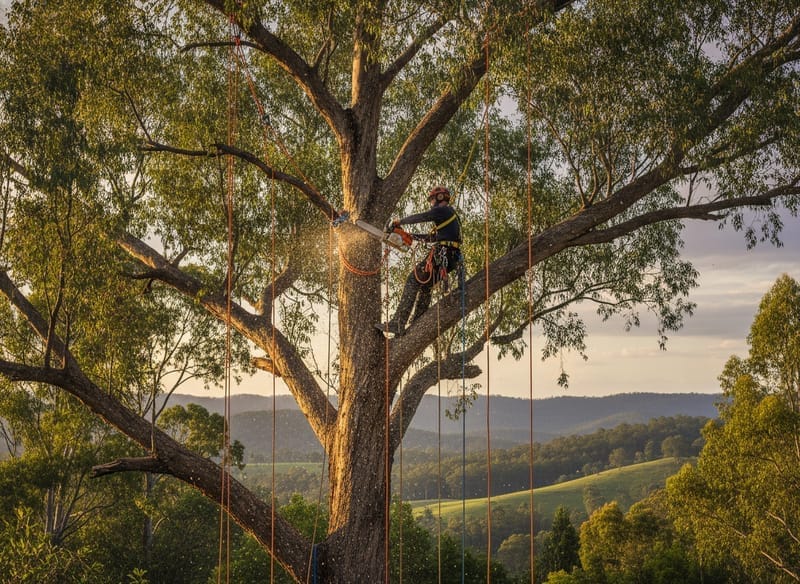
For broken limbs suspended over structures, we use rope-access climbing techniques (single and double rope) alongside heavy-duty friction devices to lower timber in controlled sections, preventing any secondary impact damage to roofs and fences.
Heavy local rainfall saturates soils, frequently causing whole-tree uprooting. We stabilise the root plate before processing the trunk. Severing a tensioned trunk without securing it first can cause the massive root ball to violently snap back into the crater.
When a tree has crushed a structure or access is completely blocked on steep hinterland blocks, we deploy elevating work platforms (cherry pickers up to 26m) or spider lifts. For extremely tight access, we employ loader cranes to lift heavy logs safely over your property.
We take comprehensive before-and-after photographs and provide itemised quotes breaking out each tree, ensuring your emergency tree removal claim can be processed smoothly and directly by your insurer without frustrating delays.
When a major weather event strikes the Mid North Coast, efficiency, safety, and clear communication are our top priorities. Here is our step-by-step approach from your initial call to job completion for Storm Damage Tree Removal Bonny Hills.
First, we prioritise emergency calls. Upon arriving at your property, our AQF Level 3 climbers and AQF Level 5 consulting arborists conduct a rapid but thorough site assessment. We identify immediate risks—such as a fractured swamp mahogany leaning over your roof or blocking your driveway—and secure the work zone to protect your family and passing traffic.
Next, we provide a detailed, itemised quote. Because storm work often involves insurance claims, we document the damage meticulously. We capture before-and-after photographs and provide precise descriptions of the required work, ensuring your claim is ready for submission to your insurer.
Once approved, our crews deploy the appropriate gear. Using top-handle climbing saws for elevated work and heavy ground saws (like the MS500i or 572XP) for cross-cutting, we systematically dismantle the hazard. We chip the smaller branches into mulch on-site and load heavy logs into our tipper trucks.
Finally, we perform a comprehensive site cleanup. We use mini-loaders on accessible blocks to clear the yard of all remaining hazardous debris, leaving your property safe, tidy, and ready for you to begin the repair process.
Storm recovery is inherently high-risk work, and our team adheres strictly to all Australian safety standards. Any pruning of storm-damaged but retainable native trees is performed strictly to AS4373 - Pruning of Amenity Trees, ensuring we do not weaken the tree further through incorrect cuts. We operate fully insured with comprehensive Public Liability and WorkCover, giving you complete peace of mind while heavy timber is dismantled above your home. Our crew holds all necessary tickets, including Working at Heights, EWP licences, Traffic Management for roadside clearing, and chainsaw felling qualifications, guaranteeing that every piece of machinery is operated by a certified professional.
Bonny Hills experiences intense humid subtropical weather, from severe summer squalls to relentless East Coast Lows pushing gale-force winds onto saturated ground. This local climate combination frequently leads to massive root-plate failures in large native species like blackbutt, tallowwood, and broad-leaved paperbark, especially along the sandy coastal dunes and softer floodplain soils.
When dealing with emergency tree work, understanding Port Macquarie-Hastings Council regulations is vital. While a permit is generally required to remove any tree over 3m tall or with a trunk diameter of 100mm, dead, dying, or immediately dangerous trees can be exempt if the council is satisfied. However, you must have written arborist justification and photo evidence before making any cuts. Our AQF Level 5 arborists provide this critical documentation. If your property falls within a mapped Koala Habitat Area or an Asset Protection Zone under the bushfire overlay, we ensure your emergency cleanup remains completely lawful and compliant with local planning schemes.
Once the immediate storm hazards are removed, it is crucial to monitor your remaining canopy. Keep a close eye on newly exposed trees that were previously sheltered by the fallen timber, as they may now be susceptible to wind throw. You should also watch for hanging deadwood or weak epicormic growth sprouting from snapped branches over the coming months.
We highly recommend scheduling a routine hazard assessment with our arborists before the next storm season (October to March). Proactive, AS4373-compliant canopy thinning and selective deadwooding can dramatically reduce the wind sail effect on your large coastal eucalypts, minimising the risk of failure. If council approvals require replanting, we can also advise on high-quality stock meeting AS2303 standards to safely restore your landscape.
Storm cleanup is quoted based on the volume of debris and complexity of the work.
Call us for a prompt, free quote to clear your storm damage.
Servicing storm-affected properties in Bonny Hills and neighboring areas.
Contact our rapid-response team to clear the debris safely.
Get a Free Quote